Showing posts with label 3. Features (Stories). Show all posts

Thursday, April 30, 2009

Lab 10: Maple Line Farm

I waited on the dust road for the tour guide to appear, and after 15 minutes he finally arrived. I wanted to take pictures with my camera but I unfortunately left it in the dorm. Rich West, the tour guide, explained that the farm has been around for 105 years planting tobacco and vegetable until 25 years ago where it moved away from that business and into the dairy farming.

The registered Jersey cows are rich in butterfat which helps makes their products more creamy. The demand for their milk is so high that they must rent out land nearby to supply their demand. The farm not only produces milk in different flavors but they also make heavy cream, and 5% of their business is selling beef.

The 10 employees there must work through 125 acres of land and an extra 60 acres that they rented from neighboring land. Each day the cows are milked twice a day at 8am and then at 3pm. Those 4 1/2 year old cows are pleasant to be with, the calf I was playing with kept on sucking on my finger as if it was a teat.

I could not run back to my dorm to get my camera, but I did bring back a quart of milk. I saw this project online that I wanted to try, it's making a light tent. So the milk bottle will be my subject. I had to substitute the light bulb with a florescent one which gave the picture the orange tint. I made this project so that I could experiment with lighting. If I photoshop the picture I could get the colored tint to disappear but it would also wash out the current white that appears in the photo. The overexposure would make the text on the bottle hard to see. When I redo this photoshop I have to replace the bulb but I also have to alight the paper to better hide the brown box lining on the corner. I will also have to get the t-shirt to be fitted around the box so that there aren't any wrinkes/waves in the photo.

Wednesday, April 29, 2009

Lab 8: Foxbard Farm


Mr. John Payne gave the group a tour of the Foxbard Farm. The farm has been around since the 1700's which was bought by John Payne's father of 1,150 acres of land, at the time it was a tabacco farm but it wasn't until 1943 that the owner switched over to be a dairy farm, filling their pastures with milking short-horns. After passing away Payne's son, John, took ownership of his father's land in 1998 and ever since then the farm has been run by John. Currently the farm has 100 - 130 heads of cows, most of them were bred naturally.

These pictures were shot with my 1.8 mega pixel camera. Now a days, a regular point-and-shoot camera has about 7.1 mega pixel. Mega pixels are one of the features to look for when purchasing a camera. The mega pixels indicate how much pixels are in a inch of a photo. Since my camera has such a low resolution of 1.8 mega pixel, you can notice that blocks are used to make up the photo. The higher the mega pixel the smoother and crisp the image comes out to be and no amount of photoshopping can make this photo look like it was taken from a 7.1 mega pixel camera.

Sources: The Pixels Underneath Your Photo

Monday, April 27, 2009

Lab 7: Hadley Farm


This was taken during my Livestock Classics class competition. I was in the sheep group, and my sheep's name was Lambchops. This photo is not mine but the photographer did a pretty good job at taking this picture. She had us in a tight squeeze to fit into the view of the lens and the people positioning is good. I like that the right side of the picture is packed with people and going to the left the amount of people narrow down and trails off with a sheep. The faces are clear in the picture but it could use some photoshopping because it looks dreary. It was a cloudy day so there wasn't much sun, but with a little help of photoshop I would edit the brightness of the image and add some contrast so the colors would not wash out.

Lab 6: Before and After Diemand Farm (Poultry)

Before After

The before picture of this sign was depressing as its overall color was gray and a little bland might I add. So what I did was made the picture warmer by allowing the yellow (foliage) to be more yellow and I made the photo a brighter as well as adjusting the contrast to have the tree's branches pop up more.

The lighting in this barn was not that great even with the natural lighting of the sun coming into the shed, so I adjusted the brightness to have the sun reflect off of the girl's hair on the left of the after picture.

This picture required a little more than just adjustment in brightness and contrast. I applied a layer, where I adjusted the subject (the chick) to be brighter and sharper and then I applied a blur to the background so that the subject would pop up more.

This picture did not require much work as the camera had a soft focus which means that the picture is blurry but still maintaining it's sharp edges. All the picture needed was brightness.

I did not really know what to do with the picture because I thought it was pretty good. I just played around, by sharpening the dog's eye to intensify what the dog was looking at.

Not must here, soft focus, and an adjustment in contrast.

I was at a Chicken/Turkey Farm. For class we learned how chickens were slaughtered, but I wont go into that since I have these pictures up. These chickens were in the pen chirping and running away from our hands but eventually we would catch one. The farm sold their cracked eggs up front but they were still good and cheap. They also sold chicken potpie, chicken salad, chicken sandwich, along with turkey potpie, turkey dinner, everything chicken and turkey fresh from the farm.

Lab 5: Intro to Poultry (Egg Quality)


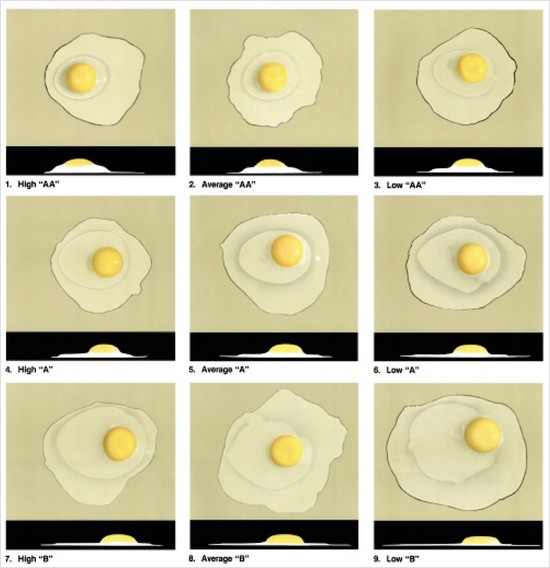
The image was created by jjwiseman. The class had an indoor lab so there was not any animals we got to see. I picked this image to talk about egg quality but I really picked it because I liked how jjwiseman put the eggs side by side along, with an above shot and a side shot. You can clearly see how wide the egg stretch but on the side you can see how tall the yoke is along the the egg whites still clinging onto the sides of the yoke; when you compare egg AA wih egg B.

There is a vintage old look to these photos as well. The coloring isn't as rich and the white looks faded with some graining spots all over.

Lab 4: Parson's Farm (Swine & Sheep)

Parson's Farm specialize in artificially bred pigs and sheep. These farm raised animals are fed with a special grain feed of protein, but the piglets gets their own food from their mother's teats. Piglets are very dominate they do not share the mother's teat with anyone and they will not drink from any other teat except their very own. Pigs are fierce animals to come across, their odor can do some damage to a person's nose. I was at the pig farm for quite some time and the smell was fowl enough to get me nauseated. The pigs are well cared for and all but the odor is just something that can't be treated.

These pictures were taken at the Hadley Barn, when the class was doing castrations *fun! I did not adjust the last 3 pictures below because I thought the images were good as they are so I'll talk about the camera angle. As for the 2 pictures above I had to do some editing. I found the background distracting because Serena's face is a little distracting and stealing some attention from Kayleigh, the one holding the piglet in the arm.


I wanted the audience to experience what I was feeling when the piglets were staring at me. I took this shot with the piglet's eye in mind. I did not have the eye positioned in the center of the photo because I was following the Rule of Thirds which is a rule to have a subject's eye lie in the intersecting points of this image. I am still a amateur in the art of photography but the point is to have the eye to be positioned near the point of intersection.


There was not any rules I was following for this one just put my camera in front of the pigs. I like how there is a wall on one side and on the other it's free, there's also a pig facing that direction as well. But mostly I like how the piglet just stares at at the looking of the photo.


The pigs are on one another, but it's basically the same angle as the picture above. Except I kept the light to contrast the dark. When you look at the picture from top to bottom the light exposure drops and gets darker at the bottom.

Lab 3: Animal Health

Animal healthy is very important especially if it is being used as food. Some diseases or infection can be zoonotic, meaning it can be transferred from animal to human. None of the sheep in the picture was diseased, but they were stressed and tired which could lead to sickness. These sheep were handled with the utmost care, but putting them in new environment is very frightening. Aside from that I wanted to talk about how well this picture was taken. The people were alighted in a straight light but the cameraman made it look like we were alighted diagonally. In this angle you can see the ewe's nicelly finished coat of wool and fully washed coat of white. But some improvements could help to make the photo better, like giving the person on the right some more space so not to seem like she's about to be cut out and there is enough space because to the right there is some emptiness that can be best be utilized by doing such.

Lab 2: Beef Cows (Brood Cows and Calf Management)


During spring break, I went to a slaughter house in Pennsylvania for my Artificial Insemination class. The photo was taken by my professor, and although he's a great teacher and knowledgeable in animals he took a very shoddy picture. The faces in this picture are hard to see and the positioning is a little tilted. If I was taking this shot I would have moved closer to the group and used some sort of point of reference to make sure that the image was not so tilted.

Lab 1: Lambing


Feb 7, 2009:
Tonight I will be at the Hadley barn, watching over the ewes. Everyone in ANISCI103 has to spend at least one night with the lambs. The purpose of this lab is to show students the parturition of a ewe lambing, and to watch out for signs of breech births, so to prevent any lambs from suffocation while still in the ewe’s placenta.

Postpartum
At the barn I am required to make sure certain things happen after the lambing. During the parturition my group must call a TA about the lambing, so that the TA can come up to assist us in caring for lambs. The navel of the ewe is dipped in 7% iodine solution. Within an hour of birth, the lambs must nurse, because it is essential the lamb gets something to eat and that the mother has accepted the lamb as her own or else the mother will not allow the lamb to get nourishment from her teat.

After the parturition, the placenta of the ewe should drop after a few hours. Once the placenta falls, it must be disposed of for sanitary reasons. The time and date of the birth is recorded to help keep track of how old the lambs are.